ISO 19650 · Information management

The EIR asks. The BEP answers.

Most information management failures on a project are not failures of either document. They are failures of the handover between them — a requirement written loosely enough that the response can be vague, and nobody notices until the information arrives wrong.

Both are free, interactive, and run entirely in your browser. No signup and no gate: the report appears on the page, and asking for a copy by email is optional.

Two documents, two sides of one appointment

ISO 19650-2 puts a specific exchange at the centre of the delivery phase: the appointing party states what information it needs, and the prospective lead appointed party states how it will produce it. Everything downstream inherits the quality of that exchange.

Client side · asks
Exchange Information Requirements

What the appointing party needs delivered, when, in what form, and to what level of information need. Issued with the tender documentation, so it is the thing the supply chain prices against. An EIR that cannot be priced is an EIR that will be answered with a paragraph of intent.

Written by  appointing party
Issued at  tender / pre-appointment
Feeds from  OIR, AIR, PIR
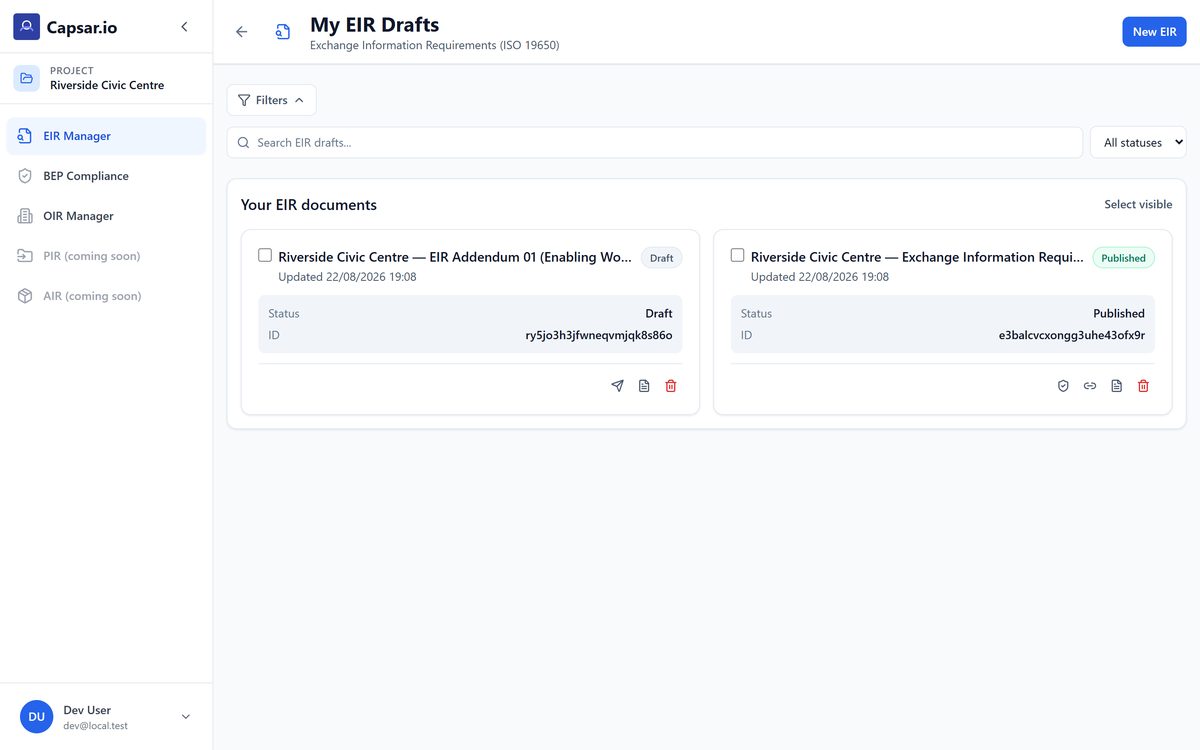
EIR drafts list holding a published Exchange Information Requirements document and an enabling-works addendum, each with its status and last-edited date. EIR Manager appointing party side · live demo, no account
responded to by
Supplier side · answers
BIM Execution Plan

How the delivery team will meet those requirements — method, standards, capability, and the people responsible for each information container. Submitted pre-appointment as a proposal, then confirmed after appointment with the TIDPs and MIDP that turn the promise into a schedule.

Written by  lead appointed party
Issued at  pre- then post-appointment
Feeds into  TIDP, MIDP, CDE setup
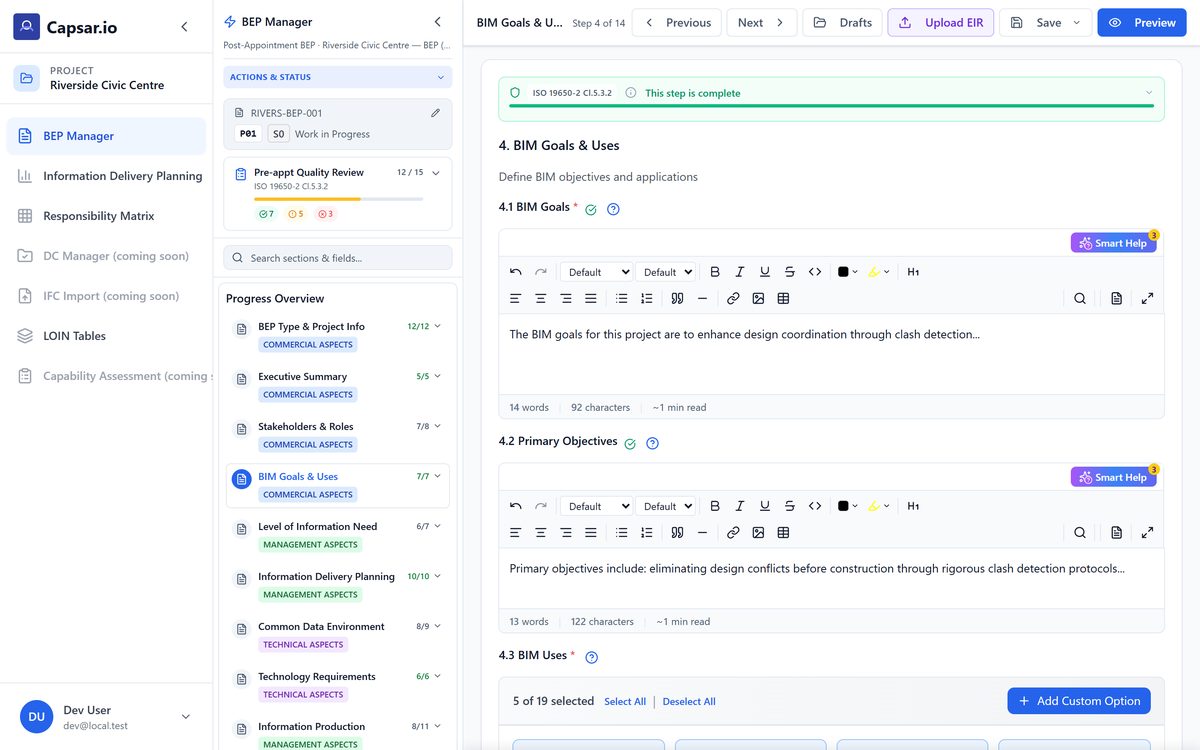
The BEP wizard on step 4 of 14, BIM Goals & Uses, with the ISO 19650 progress sidebar on the left and Smart Help offered on every field. BEP Manager lead appointed party side · live demo, no account

Where those two documents sit

ISO 19650-2 breaks the delivery phase into eight numbered activities. The EIR is written at 5.2 and answered at 5.3; the appointment at 5.4 turns that answer into a schedule, and acceptance at 5.7 is where the whole exchange is finally tested. Pick an activity to see the standard’s own sub-activities, who is responsible, and what it produces.

Clause 5 of ISO 19650-2:2018 — the delivery phase, activity by activity.
Above the line · appointing party On the line · both parties Below the line · lead appointed party
ISO 19650-2 · 5.1

Assessment and need

Responsible Appointing party

Before anyone is asked to price anything, the appointing party works out what it needs and what will govern it: who manages information, which milestones it lands on, which standard it is written to, and which CDE it lives in.

Sub-activities
  1. 5.1.1Appoint individuals to undertake the information management function
  2. 5.1.2Establish the project’s information requirements
  3. 5.1.3Establish the project’s information delivery milestones
  4. 5.1.4Establish the project’s information standard
  5. 5.1.5Establish the project’s information production methods and procedures
  6. 5.1.6Establish the project’s reference information and shared resources
  7. 5.1.7Establish the project’s common data environment
  8. 5.1.8Establish the project’s information protocol
Produces
  • PIR
  • Information delivery milestones
  • Project information standard
  • Production methods and procedures
  • Project CDE
  • Information protocol
ISO 19650-2 · 5.2

Invitation to tender

Responsible Appointing party

The requirements become tender documentation. This is where the EIR is written and issued, alongside the reference information the supply chain needs in order to answer it — and it is the last moment a requirement can be added without a variation.

Score an EIR against this
Sub-activities
  1. 5.2.1Establish the appointing party’s exchange information requirements
  2. 5.2.2Assemble reference information and shared resources
  3. 5.2.3Establish tender response requirements and evaluation criteria
  4. 5.2.4Compile invitation to tender information
Produces
  • EIR
  • Reference information and shared resources
  • Tender response requirements
  • Evaluation criteria
ISO 19650-2 · 5.3

Tender response

Responsible Prospective lead appointed party

The prospective delivery team answers clause by clause: a pre-appointment BEP, evidenced capability and capacity behind it, a mobilization plan and a risk register. A response that reads like a brochure is a response nobody scored against the EIR.

Check a pre-appointment BEP
Sub-activities
  1. 5.3.1Nominate individuals to undertake the information management function
  2. 5.3.2Establish the delivery team’s (pre-appointment) BIM execution plan
  3. 5.3.3Assess task team capability and capacity
  4. 5.3.4Establish the delivery team’s capability and capacity
  5. 5.3.5Establish the delivery team’s mobilization plan
  6. 5.3.6Establish the delivery team’s risk register
  7. 5.3.7Compile the delivery team’s tender response
Produces
  • Pre-appointment BEP
  • Capability and capacity assessment
  • Mobilization plan
  • Risk register
  • Tender response
ISO 19650-2 · 5.4

Appointment

Responsible Appointing party and lead appointed party

The promise becomes a schedule. The BEP is confirmed, responsibility is named container by container, and the task teams’ TIDPs aggregate into one MIDP the programme can actually be held to.

Check the confirmed BEP
Sub-activities
  1. 5.4.1Confirm the delivery team’s BIM execution plan
  2. 5.4.2Establish the delivery team’s detailed responsibility matrix
  3. 5.4.3Establish the lead appointed party’s exchange information requirements
  4. 5.4.4Establish the task information delivery plan(s)
  5. 5.4.5Establish the master information delivery plan
  6. 5.4.6Complete lead appointed party’s appointment documents
  7. 5.4.7Complete appointed party’s appointment documents
Produces
  • Confirmed BEP
  • Detailed responsibility matrix
  • Lead appointed party’s EIR
  • TIDP per task team
  • MIDP
  • Appointment documents
ISO 19650-2 · 5.5

Mobilization

Responsible Lead appointed party

Nothing is produced until the setup is proven: people in place, technology configured, and a live test of the information production methods and procedures against the project CDE.

Sub-activities
  1. 5.5.1Mobilize resources
  2. 5.5.2Mobilize information technology
  3. 5.5.3Test the project’s information production methods and procedures
Produces
  • Mobilized resources
  • Configured information technology
  • Tested methods and procedures
ISO 19650-2 · 5.6

Collaborative production of information

Responsible Delivery team — lead and task teams

Information is generated, quality-checked, reviewed and only then shared. The check → review → approve loop is the standard’s answer to the question nobody writes down: who says this container is fit to issue?

Sub-activities
  1. 5.6.1Check availability of reference information and shared resources
  2. 5.6.2Generate information
  3. 5.6.3Undertake quality assurance check
  4. 5.6.4Review information and approve for sharing
  5. 5.6.5Information model review
Produces
  • Shared information containers
  • Quality-assurance records
  • Project information model in progress
ISO 19650-2 · 5.7

Information model delivery

Responsible Lead appointed party, then appointing party

Submission, authorization, acceptance. The lead appointed party authorizes what the task teams produced; the appointing party accepts it against the EIR it issued back at 5.2. This is where a vague requirement finally becomes an argument.

Sub-activities
  1. 5.7.1Submit information model for lead appointed party authorization
  2. 5.7.2Review and authorize the information model
  3. 5.7.3Submit information model for appointing party acceptance
  4. 5.7.4Review and accept the information model
Produces
  • Authorized information model
  • Accepted PIM
  • Acceptance record
ISO 19650-2 · 5.8

Project close-out

Responsible Appointing party

The project information model is archived and what the operator needs passes into the asset information model. Lessons learned go back upstream, into the requirements of the next project.

Sub-activities
  1. 5.8.1Archive the project information model
  2. 5.8.2Capture lessons learned for future projects
Produces
  • Archived PIM
  • Asset information model update
  • Lessons learned

Where the handover actually breaks

None of these are exotic. They are the four that turn up on almost every programme, and every one of them is visible before appointment if somebody looks.

  1. EIR

    Level of information need is undefined

    The EIR asks for models and drawings but never says how much detail, in whose format, or for which decision. The supply chain guesses, prices its guess, and delivers something defensible that nobody wanted.

    Costs More rework than the other three combined

    How to write a level of information need

  2. BEP

    The BEP answers a template, not the EIR

    A pre-appointment BEP written from the last job’s document responds to requirements the client never issued, and stays silent on half the ones they did. Nobody scores it clause by clause, so it passes.

    Costs A response nobody scored, accepted anyway

    Who writes the BEP, and who else has to

  3. CDE

    The CDE exists, but the workflow does not

    Both documents name a common data environment. Neither states the naming convention, the status codes, who approves a transition, or what happens to a container that fails one.

    Costs A platform bought, a governance never written

    What a CDE has to do under ISO 19650

  4. MIDP

    Handover is not tied to a stage

    Information delivery milestones sit on a separate list from the project programme, so they slip without anyone reporting a slip. The data that should have accumulated across the stages was never captured.

    Costs An asset information model with gaps that cannot be backfilled

    How TIDPs roll up into a MIDP

The document is not the deliverable. The decision somebody makes from it is.

Score the side you are actually on

Two separate tools, because they are two separate jobs at two different moments. Both run in the browser, both export a report, and neither asks for an email address.

Supplier side

BEP Readiness Checklist

You have a BEP drafted and a submission deadline. Thirty-five evidence checks across nine sections, including a set flagged ISO-critical and a final go / no-go.

35 checks · 9 sections · readiness band · about 7 minutes
  • A readiness score with a submit / do-not-submit verdict
  • Weakest sections diagnosed, with what to do about each
  • ISO-critical checks separated from the nice-to-haves
  • A PDF report for the bid team
Open the checklist Open the BEP Manager demo lead appointed party side · no account

The ones that come up first

Which one do I need?

Whichever side of the appointment you sit on. If you are commissioning the work, you own the EIR. If you are bidding for it or delivering it, you own the BEP. Advisors working with both sides need to read each document as the other party will.

Pre-appointment or post-appointment BEP?

Both, and they are not the same document. The pre-appointment version is a proposal submitted with the tender. The confirmed version comes after appointment, carrying the mobilisation detail, the TIDPs and the MIDP that the proposal could only promise.

Where do OIR, AIR and PIR fit?

Upstream of the EIR. Organisational and asset information requirements describe what the business needs from its estate over the long run; project information requirements narrow that to one project. The EIR is where they become something a supplier can price.

Do the tools store anything?

No. Both run entirely in your browser and keep your answers in local storage so a refresh does not lose them, and there is no gate: the report appears whether or not you fill anything else in. Each tool ends with one optional field — ask for the report by email and I receive your address and the summary on screen, never a copy of your project.

If the score came back low, the fix is usually specific.

I write EIRs client-side and BEPs supplier-side, and I built Capsar.io to keep the requirements traceable between them. Bring the document and the deadline — thirty minutes is usually enough to say what is actually wrong with it.

info@noeinsolutions.com